Generic alerts create noise because the same headline goes to everyone. A useful sales trigger connects a sourced event to an account your team serves, a problem you can credibly help with, and a next action that respects the buyer’s context.
Use this four-step test: verify the event, connect it to a plausible business implication, check the CRM relationship, and write an outreach angle that asks rather than assumes.
Leadership changes
A new CEO, CFO, CRO, general counsel, or board member may signal changes in priorities, governance, investment, or operating rhythm. Use the company’s own newsroom, leadership page, or regulatory filing as the source.
- Check whether the role is new, interim, or a planned succession.
- Review what the executive has publicly said about priorities.
- Frame outreach around the transition rather than claiming an urgent need.
Mergers, acquisitions, and capital events
Transactions can create integration work, operating-model changes, new geographies, and altered risk. The useful question is not simply “Was a deal announced?” but “Which part of this change overlaps with the work our team does?”
For public companies, start with the company announcement and relevant filing in SEC EDGAR. Distinguish an announced transaction from one that has closed.
Expansion and operational change
New facilities, market entries, capacity investments, restructurings, and major hiring plans can change systems, processes, coverage, and vendor needs. Verify the location, timing, and actual scope before routing the signal to a rep.
- Prefer a company announcement, planning record, or government economic-development source.
- Use geography to determine whether the event belongs to the rep’s territory.
- Connect the event to an existing account plan or open opportunity when possible.
Regulatory and legal events
Filings, investigations, consent orders, lawsuits, and rule changes can affect priorities, but they require careful language. Link directly to the regulator or court source, separate allegations from findings, and avoid sensationalizing the event.
Cybersecurity events
Public breach disclosures and vulnerability notices can create legitimate operational questions. They are also sensitive. Use authoritative notices such as company disclosures, regulator publications, or the CISA Known Exploited Vulnerabilities Catalog. Never imply access to private incident information.
A CRM-ready trigger workflow
- Source: Store the original URL and publication date.
- Match: Resolve the company to the correct Dynamics Account or Lead.
- Qualify: Apply industry, territory, account status, and configured relevance criteria.
- Explain: Summarize why the event may matter without presenting speculation as fact.
- Act: Give the rep a question, next action, and source link on the CRM record.
- Review: Let the rep dismiss irrelevant signals so criteria can improve.
Example: leadership succession
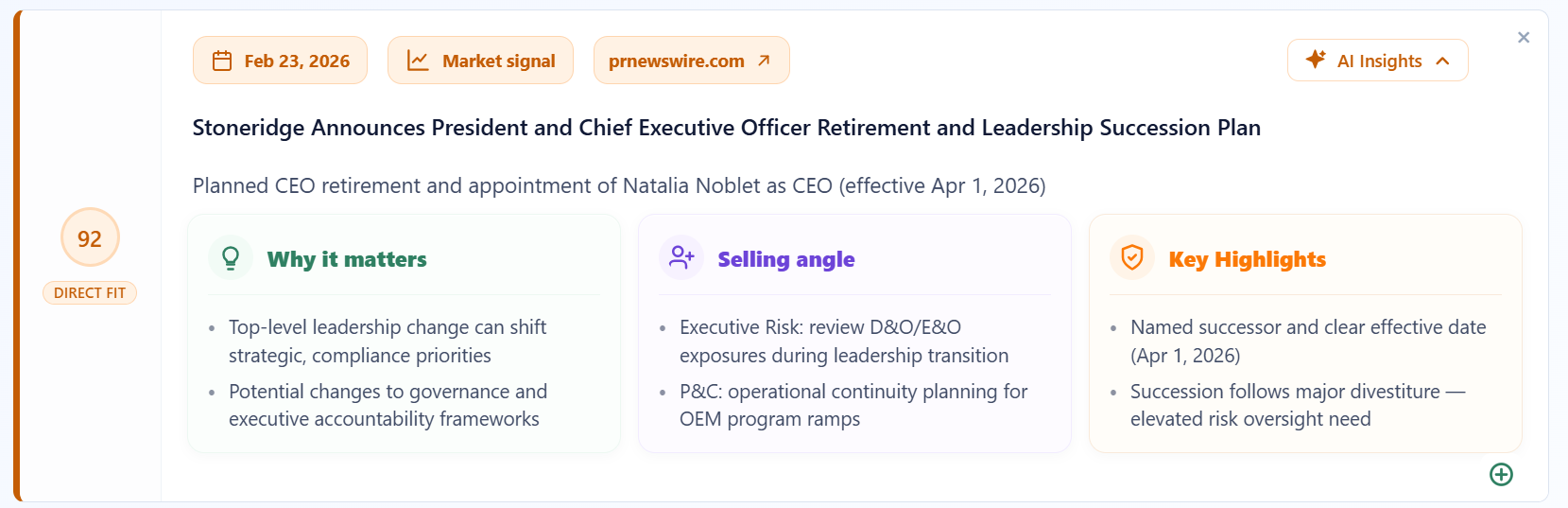
A sourced CEO succession notice does not automatically mean an opportunity. For a team advising on operational risk, however, it may justify reviewing the account plan, checking existing relationships, and asking whether transition planning has changed priorities. The source, relevance explanation, and proposed question should travel together.
10 sales trigger event examples with sample emails
These illustrative B2B buying signals are prompts to research, not proof of buying intent. Verify the event and recipient’s role, replace the placeholders with accurate details, and send only when the offer fits. The sample emails are starting points for a human-reviewed conversation.
1. New CFO appointed
Possible need: Finance reporting or forecasting priorities may change.
Person to contact: CFO or finance transformation lead
Sample email: I saw your announcement welcoming [Name] as CFO. Are reporting or forecasting improvements part of the team’s priorities? If useful, I can share a short example relevant to [company].
2. CEO succession announced
Possible need: Leadership may revisit operating priorities.
Person to contact: Existing executive sponsor or strategy lead
Sample email: I read the succession announcement. Has the transition changed any priorities in our current account plan? Happy to align our next discussion with the goals your team has shared.
3. Acquisition announced
Possible need: Integration planning may affect systems and processes.
Person to contact: Integration lead, CIO, or operations sponsor
Sample email: I saw the proposed acquisition of [business]. If systems alignment is on the integration agenda, would a short checklist of reporting and process questions be useful?
4. New facility announced
Possible need: A location launch may need new processes, equipment, or coverage.
Person to contact: Plant manager or operations lead
Sample email: I read about the planned [location] facility. What needs to be ready operationally before opening? We help with [relevant capability] and could share a launch-planning example.
5. Capacity expansion confirmed
Possible need: Higher throughput may expose process bottlenecks.
Person to contact: VP of operations or continuous improvement lead
Sample email: Your expansion announcement caught my attention. Are any existing handoffs or reporting processes changing as capacity grows? I can share how we approach [relevant process] if that would help.
6. Entry into a new state or market
Possible need: Territory coverage, service, or compliance processes may change.
Person to contact: Regional sales or operations leader
Sample email: Congratulations on the announced move into [market]. How is the team handling [relevant operational question] there? Would a short discussion about your rollout priorities be useful?
7. Funding round closed
Possible need: Investment priorities may become more concrete.
Person to contact: CFO or functional budget owner
Sample email: I saw the funding announcement and the stated focus on [publicly announced priority]. Is [relevant capability] part of that plan, or is the team concentrating elsewhere right now?
8. Major contract awarded
Possible need: Delivery capacity and coordination may need attention.
Person to contact: Program director or delivery operations lead
Sample email: I read about the [contract] award. Does delivery involve changes to [relevant process]? If helpful, we could compare a few planning considerations before your team settles the operating approach.
9. Public regulatory action disclosed
Possible need: Verified obligations may require process or reporting changes.
Person to contact: Existing compliance contact or legal operations lead
Sample email: I read the published [agency] notice. If your team is reviewing the related reporting process, would a discussion of [specific relevant capability] be useful? We would follow your compliance team’s lead.
10. Company publicly discloses a cyber incident
Possible need: An existing customer may need appropriate recovery or coordination support.
Person to contact: Existing IT or security contact
Sample email: I saw your company’s public update. If our team can support any existing work within [our agreed scope], please let us know the appropriate contact and timing. There is no need to share incident details by email.
For legal or cyber events, use the company’s or regulator’s original disclosure, distinguish allegations from findings, and work through an appropriate existing contact. A company-specific authoritative disclosure matters; a general vulnerability listing does not establish that a particular business had an incident.
To operationalize the process, follow how to monitor customer and prospect news in Dynamics 365. Store the source, matched record, owner, and next task together.
Primary-source starting points
- SEC EDGAR company filings
- CISA Known Exploited Vulnerabilities Catalog
- Company investor-relations and newsroom pages for official announcements